
A swimming pool is meant to feel easy and stress-free. But when your pool water level keeps dropping quickly, chemicals vanish faster than usual, or you notice damp areas in your yard, many Los Angeles homeowners begin to wonder if it’s just evaporation or an actual pool leak. And that difference is more important than it seems.
In Southern California, hidden leaks can slowly damage soil stability, increase utility bills, weaken pool structures, and place additional stress on already limited regional water resources. According to the California Department of Water Resources, outdoor residential water use accounts for a major portion of household consumption across the state, especially during warmer months. Even a small unnoticed pool leak can waste thousands of gallons over time.
For homeowners searching for pool leak detection Los Angeles, it helps to understand how professional detection actually works so you can avoid unnecessary repairs and long-term structural issues.
Prime Detection and Renovation’s leak inspections follow a careful, step-by-step process. We don’t guess where the water is escaping. We isolate and pinpoint the source using structured testing.
Why Pool Leaks Are Common in Los Angeles
Los Angeles creates unique conditions for swimming pools. Long periods of heat increase evaporation naturally, while shifting soil conditions and seismic movement can slowly stress underground plumbing lines and pool shells over time. Older neighborhoods throughout Los Angeles County often contain aging PVC plumbing systems beneath concrete decking that may have been installed decades ago.
Tree root intrusion is another major issue in areas with mature landscaping. As roots expand underground, they can place pressure on buried return lines and skimmer plumbing.
In many cases, homeowners assume water loss is simply caused by hot weather. But when water loss exceeds normal evaporation rates consistently, professional testing becomes important.
The Environmental Protection Agency (EPA) estimates that household leaks waste nearly 1 trillion gallons of water annually in the United States. While that statistic includes plumbing systems broadly, swimming pools contribute significantly when leaks remain undetected for months.
The Difference Between Evaporation and a Real Leak
Every pool loses some water naturally. In Los Angeles summers, evaporation can become noticeable during high temperatures, dry air, and wind. But there is a clear point where water loss may point to something more serious.
Most pool professionals consider water loss consistently exceeding a quarter-inch per day suspicious, especially when it comes with other signs like:
- Air bubbles in return jets
- Constant need to rebalance chemicals
- Cracks near the pool deck
- Wet or muddy soil around equipment
- Autofill systems running more than usual
- Loose or shifting pool tiles
- Unexplained increases in water bills
One of the first checks used is the bucket test. A bucket filled with pool water is placed on a pool step. The water level inside the bucket is marked and matched exactly to the surrounding pool water level. After 24 hours, professionals just compare the water level in the bucket with the pool water around it. To reduce false readings, the test is usually done with the pool circulation off and calm water conditions.
Since both are exposed to identical environmental conditions, any additional loss from the pool itself may indicate leakage rather than evaporation alone. It is simple but surprisingly effective as an early screening method.
How Professional Pool Leak Detection Actually Works
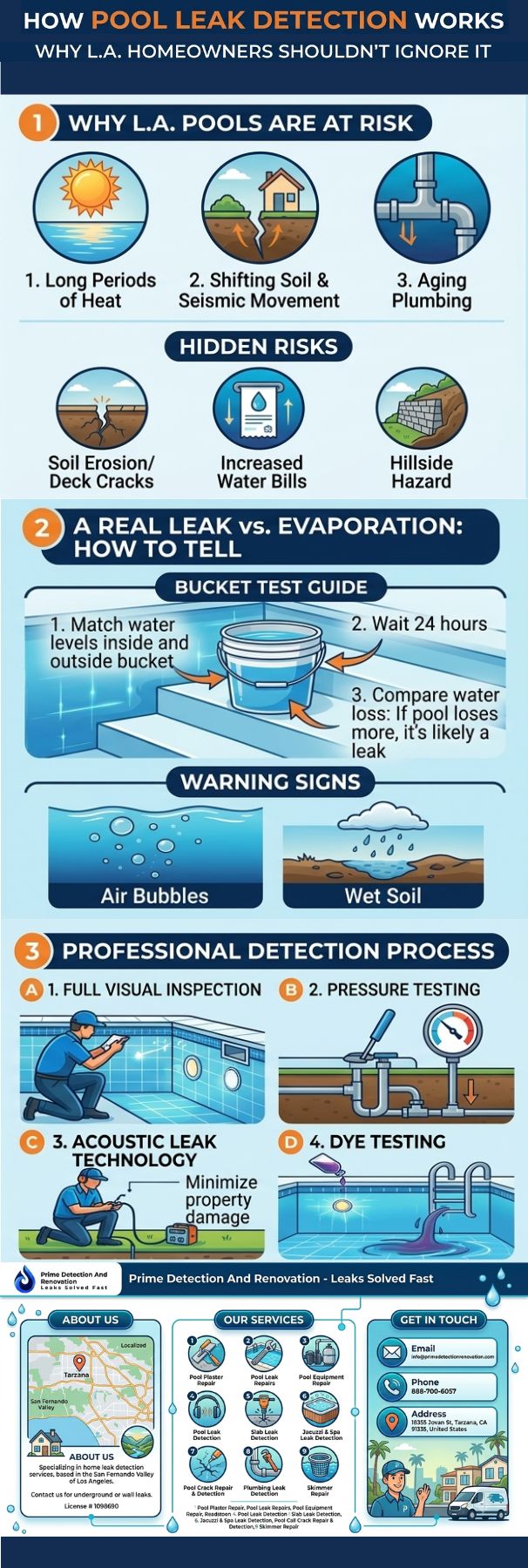
Modern leak detection is far more technical than many homeowners expect. Professional inspections usually combine pressure testing, acoustic listening equipment, dye testing, and structural checks to find where the water is leaking from. Most inspections start with a full visual walkthrough of the pool and surrounding areas.
Technicians examine:
- Pool shell surfaces
- Tile lines
- Expansion joints
- Skimmers
- Main drains
- Return fittings
- Pool lights
- Plumbing equipment
- Deck separation areas
Visible cracking alone does not automatically confirm leakage. Some surface cracks are cosmetic. Others extend deep enough to allow water migration into surrounding soil. That distinction matters.
Pressure Testing Underground Plumbing
One of the most important steps in pool leak detection involves plumbing isolation and pressure testing. Each plumbing line is individually sealed and pressurized using specialized equipment. If the pressure drops in a closed system, it usually means water is escaping somewhere in that line.
This helps narrow things down without digging anything up right away. In Los Angeles homes with older underground plumbing, return lines and suction lines are often the main trouble spots since they’re under constant pressure while the system runs.
Acoustic Leak Detection Technology
Some leaks are so small that you don’t actually see them, but they still create faint vibrations underground when pressurized water is escaping.
That’s where our technicians leverage advanced acoustic equipment. We listen for those subtle frequencies to pinpoint the exact location of the escape point. Sensitive listening devices amplify underground sound patterns that are otherwise impossible to hear naturally. Experienced technicians can significantly trace leak locations beneath concrete decking or landscaping without major demolition.
This technology becomes especially useful in high-end Los Angeles properties where minimizing damage to hardscape, tile work, or decorative surfaces is extremely important.
Rather than cutting blindly into multiple areas, acoustic detection narrows the excavation zone significantly.
Dye Testing for Structural Leaks
Structural leaks inside the pool shell itself are often tested using specialized dye solutions.
During this test, technicians place a small amount of dye near suspected cracks, fittings, or other areas where a leak might be present while the water stays still. If there’s a leak, you can actually see the dye get drawn towards the opening where water is escaping.
This method works particularly well around:
- Skimmer throats
- Pool light niches
- Step cracks
- Return fittings
- Expansion joints
Dye testing may appear simple, but interpreting results accurately requires patience and controlled conditions.
In many pools, multiple small defects exist simultaneously. Some may actively leak while others remain structurally stable.
Why Early Detection Matters More Than Homeowners Think
Pool leaks rarely stay small. Over time, leaking water can wash soil away from underneath the pool deck and nearby concrete. As the ground shifts, cracks, sinking areas, or uneven surfaces begin to surface.
For hillside properties across Los Angeles, hidden water movement underground can create even bigger concerns because those properties already deal with natural soil shifting and structural pressure.
This hidden water migration is especially critical for hillside and canyon properties from the Hollywood Hills and Bel Air to Encino and Malibu. Undetected subsurface water can rapidly accelerate natural soil shifting and weaken the retaining walls or the foundations of the structure.
Leaks can also make pool equipment work harder than it should. Pumps run longer to keep the water circulating properly, and autofill systems may constantly add water to make up for the loss. After some time, that can throw off pool chemistry, raise maintenance costs and put extra wear on the equipment.
In saltwater pools, frequent water replacement can also speed up corrosion when pool chemistry keeps changing. What begins as a minor water loss issue can eventually turn into structural renovation if ignored too long.
Common Areas Where Pool Leaks Develop
Not all pool leaks originate from the same location. In Southern California pools, technicians frequently identify problems during pool leak detection in areas such as:
Skimmer Connections
Skimmers expand and contract with temperature changes. Small gaps can form where the skimmer meets the concrete shell.
Understanding what causes pool skimmer problems early can prevent water from silently escaping into your decking infrastructure.
Underground Plumbing Lines
Underground plumbing lines are another common source. Pipes can crack due to age, shifting soil, or even root intrusion.
Pool Lights
Pool lights are also a frequent leak point because the sealing around electrical fittings can weaken.
Tile and Expansion Joints
Tile lines and expansion joints work the same way. Movement between the pool and surrounding deck slowly breaks down the sealant.
Cracks in Gunite or Concrete Shells
Structural cracks may result from soil settlement, seismic activity, or long-term hydrostatic pressure changes.
Each type of leak requires a different repair strategy, which is why accurate diagnosis matters before starting repairs.
Knowing what to do when you see cracks in your pool is vital before minor fractures turn into major structural failures.
Don’t Let a Small Leak Turn Into a Costly Repair. Act Now!
Pool leaks are easy to underestimate in the beginning. A slightly lower water line or a small wet patch near the deck can easily be overlooked at the beginning. But beneath the surface, continuous water migration can quietly affect plumbing systems, structural integrity, landscaping, and long-term property costs.
The good news is that modern pool leak detection technology allows professionals to locate many leaks with far less disruption than homeowners expect. It can be helpful to get a proper leak inspection before small issues turn into larger repairs.
Schedule a professional pool leak inspection with Prime Detection and Renovation to pinpoint the exact source before the damage spreads.